

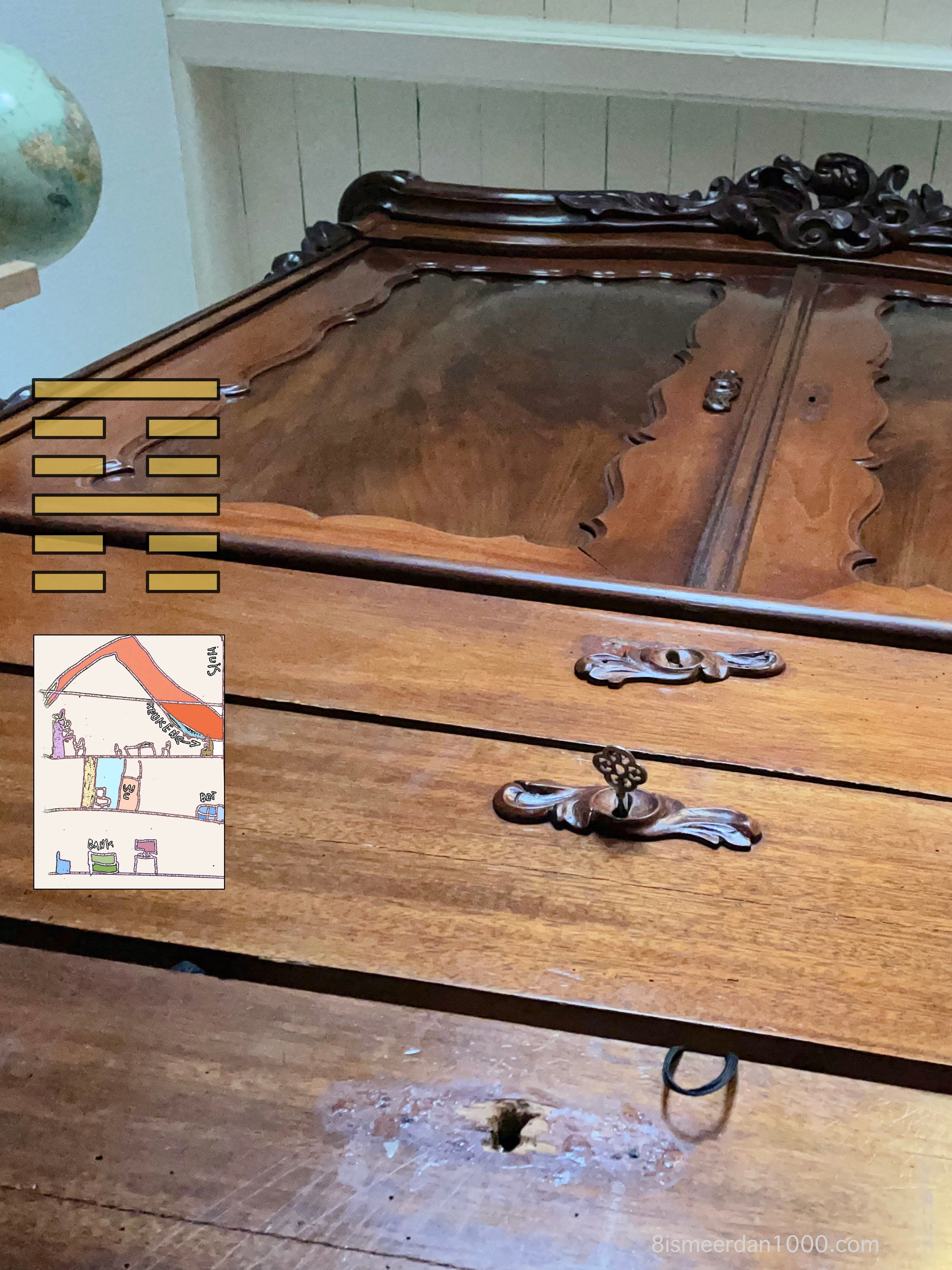
A cupboard you can live in. A cupboard that was originally made to store all your belongings. A storage easily turns into a heap or mountain. Probably. I’ll spare you the trouble of peeping inside the cupboard by keeping the doors and drawers closed, but assume that it can hold an enormous amount of junk. It was already in the house when we rented it. There was no way it would fit through the door. To store it somewhere temporarily, somewhere out of sight. So even in the pre-Ikea era, they were capable of making incredibly ugly things. Anyway, it just stayed where it was, and I actually grew fond of this oversized storage unit. It’s still not pretty, but it’s as solid as a rock. Like a mountain. I recently came across an identical piece in the Palthehof Museum in Nieuw-Leussen. It was comforting to know that I look at a museum piece every day.
The best way to get to know the I Ching and appreciate its depth is to consult it.
In the West, and particularly the United States, the Book of Changes has become popular as a form of fortune-telling, like astrology or the reading of tarot cards. But for the Chinese, and for those countries influenced by Chinese civilization, this view is too narrow. The Book of Changes has always been understood as a book of wisdom. The practitioner of the book consults it through random divination—throwing coins or manipulating long stalks of dried plants (yarrow). But these practices of divination are designed to help the questioner confront the book’s philosophy in practical, concrete contexts. It is this philosophy, learned through formulating specific questions and interpreting the answers received, that gives the work its value. And that philosophy is best encountered not through the memorization of abstract principles but through its application to specific issues in a person’s life. One absorbs the wisdom of the Book of Changes through consulting it and allowing it to become, over time, a trusted friend and confidant.
The Laws of Change - Jack M. Balkin
Perhaps the idea of entering into dialogue with a book does not appeal to you. I can imagine that. So I suggest something else: a walk through the landscape formed by the wealth of images sketched out in the Book of Changes. A short walk, which we will continue the next day exactly where we left off the day before.
I would like to start the walk at the statue of Chapter 52. Keeping Still. This chapter is about interrupting haste. Taking the time to see what is, instead of impatiently or ambitiously trying to go elsewhere, to things that are not yet there.
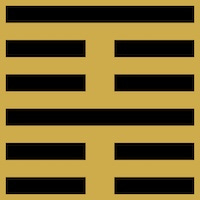
The I Ching as we know it today begins with a treatise on initiation and creation. In ancient China, there may have been two other works of this kind besides the Zhouyi, the original name of the I Ching: the Lianshan and the Guicang. Neither of these books has survived to the present day. The Lianshan is considered to have been written during the Xia dynasty (2100-1766 BC), the oldest of the three archaic Chinese dynasties. The Guicang is thought to date from the Shang dynasty (1766-1047 BC), which followed the Xia. And the Zhouyi was compiled, you guessed it, in the Zhou dynasty (1047-256 BC). The Lianshan, translated as ‘connected mountain’, opens with the equivalent of Chapter 52. Gen, The Stillness. And the Guicang with the equivalent of Chapter 2. Kun, Response (or Earth).
Since Hexagram 52 is made up of the Mountain trigram repeated above itself, this was probably an attempt to explain the name Lianshan (‘linked mountains’). Guicang (‘return and keep’) was similarly said to have belonged to Shang and to have begun with the present Hexagram 2. This also looks like an explanation of the book’s name, because Hexagram 2 consists of the Earth trigram doubled and the earth is where everything from seed to corpses returns and is kept. If these explanations are correct, both books must have been named after the hexagrams began to be analysed into constituent trigrams, late in Zhou times.
The Book of Changes, A Bronze Age Document - Richard Rutt
Knowing this, it seems appropriate to begin today's walk at Keeping Still. Beside a large Overijssel farmhouse cupboard.
To be continued in ...
