
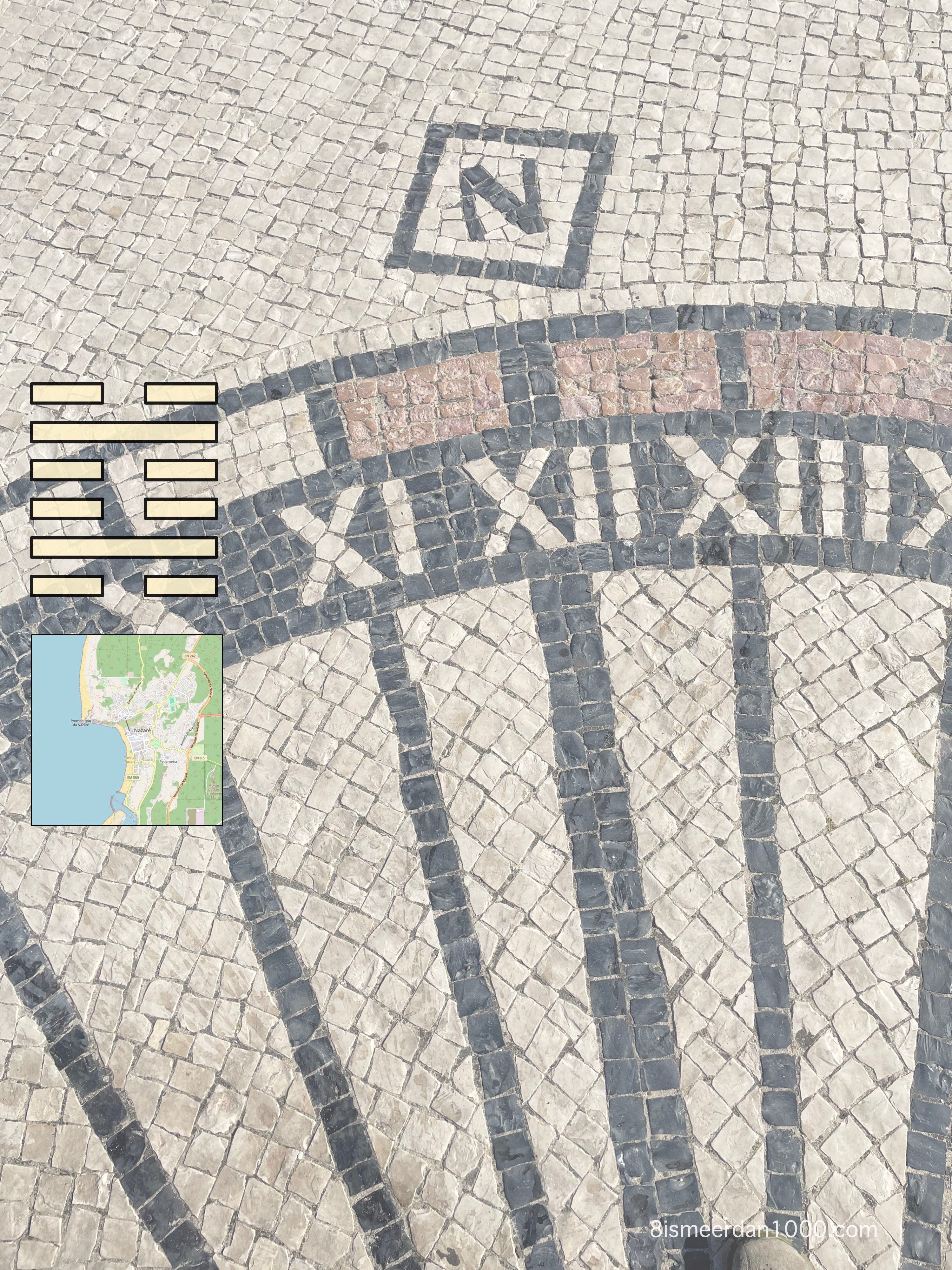
Since when did we actually start talking about the Far North and the Deep South? And what’s the connection with the Near East and the Wild West? Without doubt, somewhere in their midst you will find the navel of the world.
By the way, here above you can see, for the first time, a photo – the sort that invariably kicks off the 8>1000 posts – that wasn’t taken in good old Dalfsen. It’s been a tough pill to swallow, having to leave behind the Salland landscape of green meadows and oak trees. An uprooting in slow motion. The good news is that, after a few weeks in Portugal, the first signs of new rootlets are already visible.
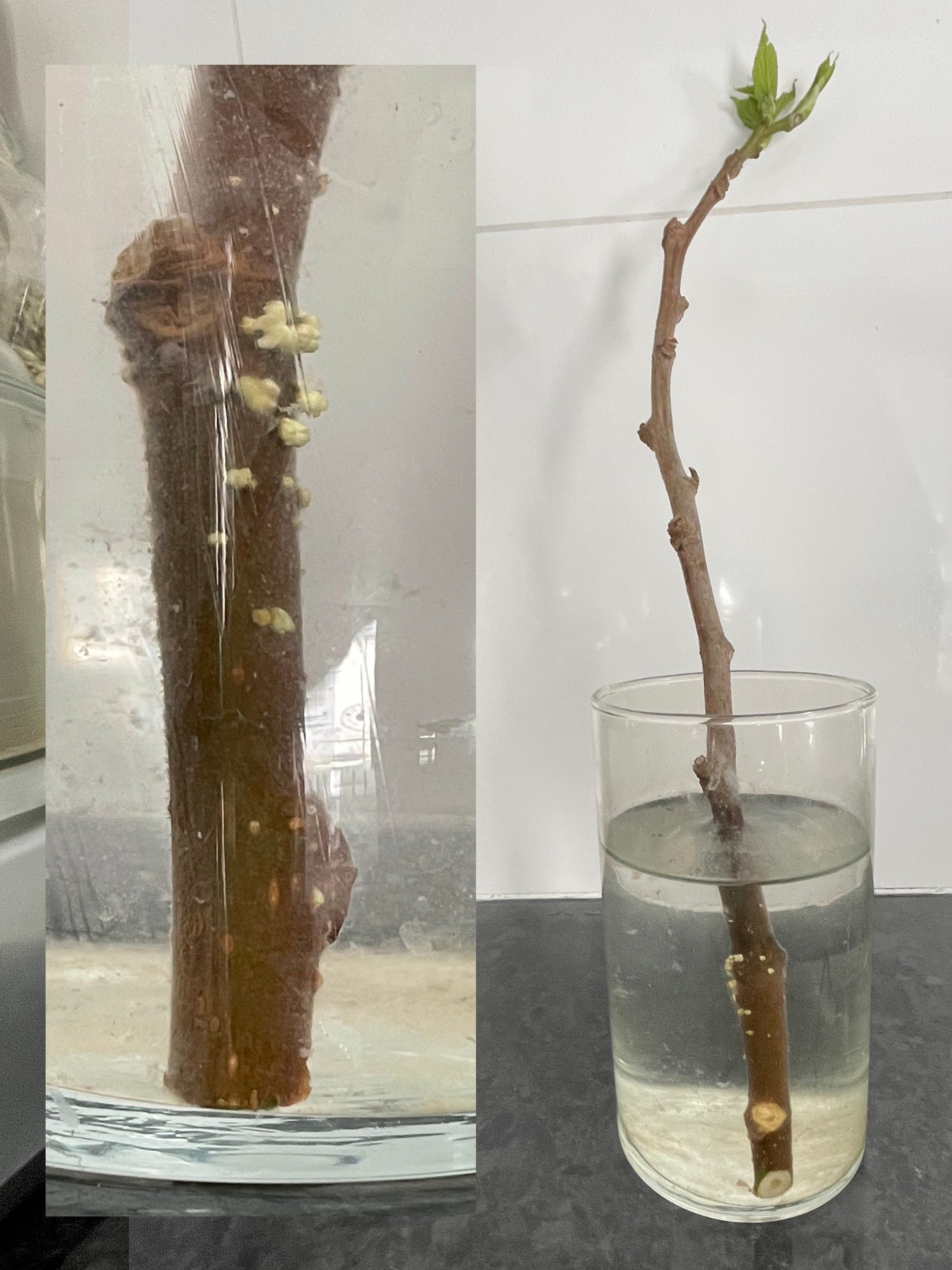
More about that cutting, from a mulberry tree, in a future post.
Now that I live in the Deep South, what would be a fitting next step in my writing, a logical new topic to explore from here, from Europe’s south? The north, perhaps? Boa ideia, vamos a isso!
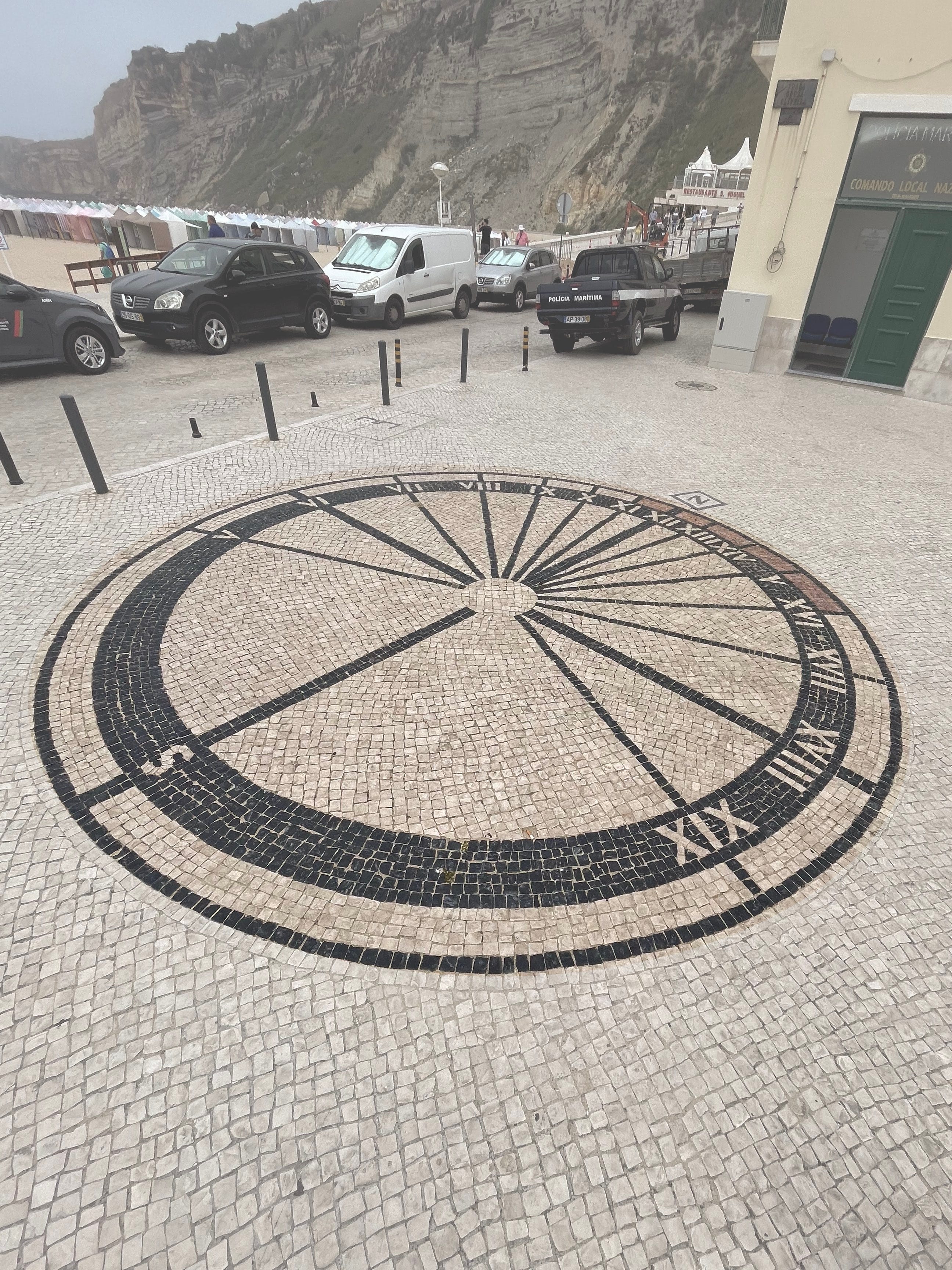
In one of Nazaré’s small squares, a life-size mosaic of a compass has been incorporated into the paving. Judging by the positioning of the initial letters of the four cardinal directions, north forms the top of the compass. This is entirely in line with the social consensus that the top position is, after all, the place rightfully due to the North.
The vast majority of modern maps are oriented towards the north: the top edge of the map points in that direction.
‘Hang on, what’s that all about?’ I can hear you thinking. ‘Orient – wasn’t that just the name for the East?’
Good point: ‘north-oriented’ is a contradiction in terms. A map like that would be aligned both to the north and to the east at the same time. That’s obviously impossible.
The earliest maps, at least in Europe, were drawn ‘facing east’ – towards the rising sun, in the direction of Jerusalem, or towards where the Garden of Eden must once have been.
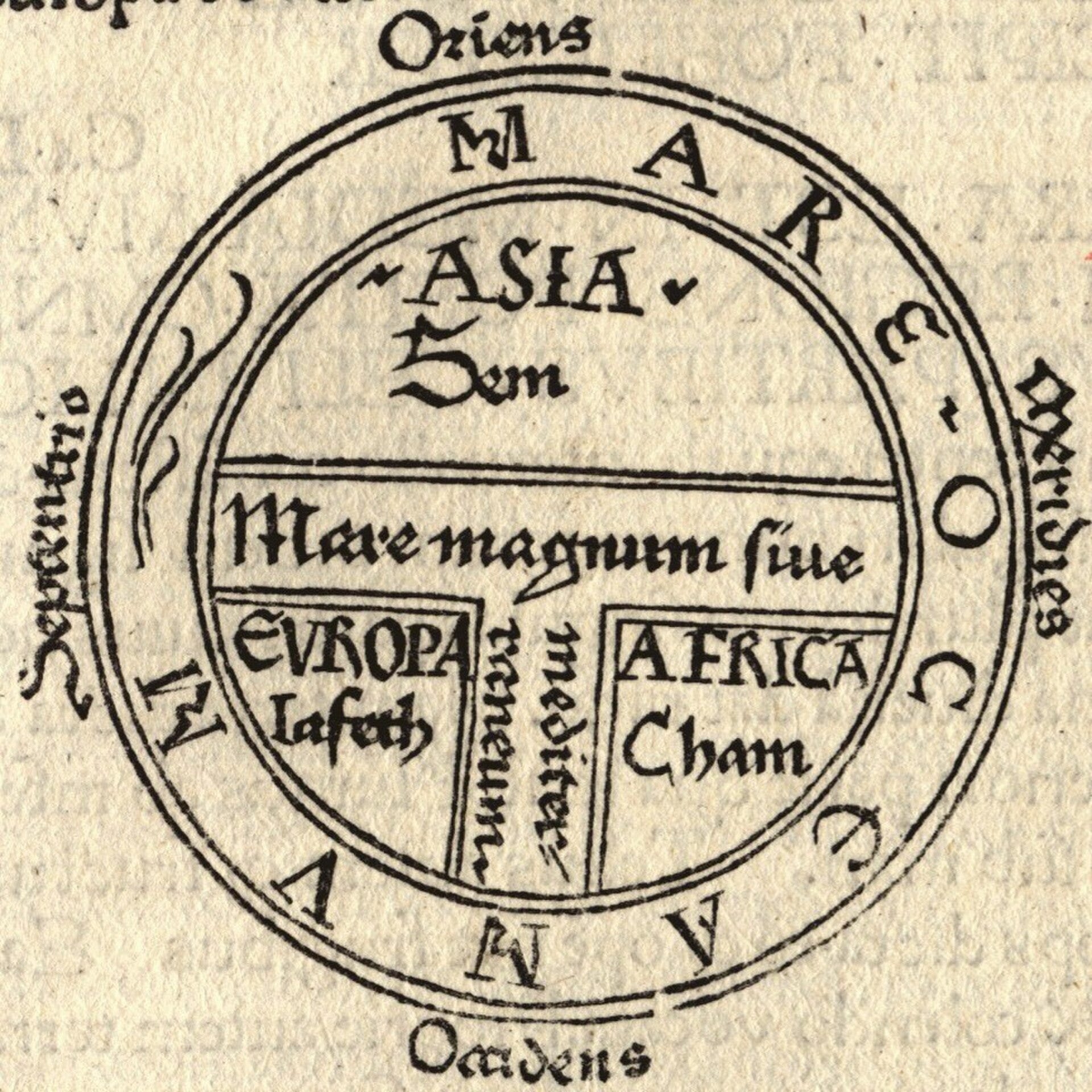
Even later, when maps were oriented as desired towards the west, north, or south, ‘orientation’ became a generic term.


From an etymological point of view, the most contradictory orientation is that towards the north, given the meaning of ‘nakara’, from which ‘north’ is derived, and which in Sanskrit means ‘underworld’. The related Greek ‘nérteros’ denotes ‘deeper’ and ‘lower’ . Plenty of reasons, one might say, to have the north arrow pointing downwards.
Old English norð- (in compounds) ‘northern, lying to the north’ (adj.); norð (adv.) ‘northwards, to the north, in the north’; from Proto-Germanic *nurtha- (source also of Old Norse norðr, Old Saxon north, Old Frisian north, Middle Dutch nort, Dutch noord, German nord), which is probably an IE word, but of uncertain origin.
It might be ultimately from PIE *ner- (1) -’left, also ‘below’ (source also of Sanskrit narakah ‘hell,’ Greek neretos ‘deeper, lower down,’ enerthen ‘from beneath,’ Oscan-Umbrian nertrak ‘left’), as north is to the left when one faces the rising sun. The same notion apparently underlies Old Irish tuath ‘left; northern;’ Arabic shamal ‘left hand; north.’
etymonline.com
In the Ba Gua, which in a certain sense also indicates the points of the compass, north (yes, it’s those clever Chinese again) is placed at the bottom. That is the location of Water, one of the eight trigrams. Didn’t Lao Zi write that water always seeks the lowest place? Water was called ‘the unfathomable’, because light cannot penetrate its depths. As you can see, the bottom of the Ba Gua is therefore coloured dark blue or black here.
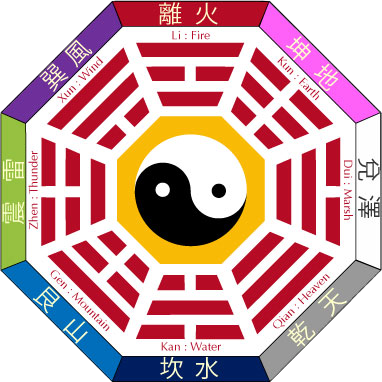
The main associations are with shadow, with the back, and with a spine. After all, when you face the sun, looking south, the freezing north is behind you.


Béi 北, north. Left: in modern script. Right: in jinwen or ‘bronze script’, which was in use during the Zhou dynasty. Two people sitting with their backs to each other; the rear, the north. For example, as in 北京 Bei Jing, the northern (capital) city.
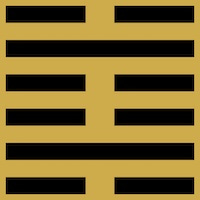
The image of Chapter 29. Dark consists of a doubling of the Water trigram. These evoke the image of an abyss, a pit, a ravine, a grave, a well, a cellar, a ditch – something unfathomable, instilling fear, yet where, at the same time, the ultimate connection and freedom can be found.
PIT: that very image makes us shudder. It reminds us of the grave. But the image of the pit is also overlaid with the necessary: the ditch we dig for irrigation, the well we dig to drink, the trench we dig for a strong foundation. The pit is everywhere in nature too. It is the canyon where the river froths white, the river we must venture to when the cliffs are dry and the wind is hot. It is the cave where we find shelter from the elements, even a place of silence for worship. So the pit is a double image. An image of the grave, of having to venture down dangerous paths for life-giving water, a place of entrapment. It is also the womb, the home of water, and thus a vital part of what we need. For the Oracle, water, as fundamental as it is, runs in a place of danger.
The Living I Ching - Deng Ming-Dao
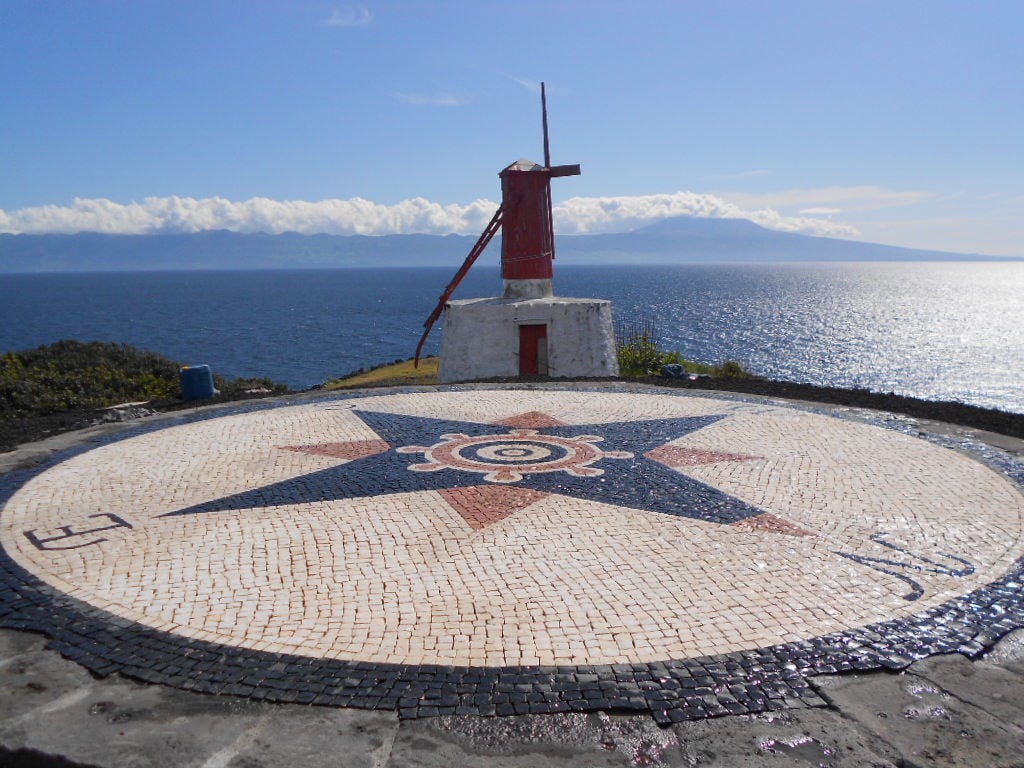
Back to the photo of the compass rose mosaic in Sousa Oliveira Square in Nazaré. It is by no means the only one of its kind. Take, for example, the compass mosaic in São Jorge in the Azores.
Or the colossal wind rose in Belém, near Lisbon.
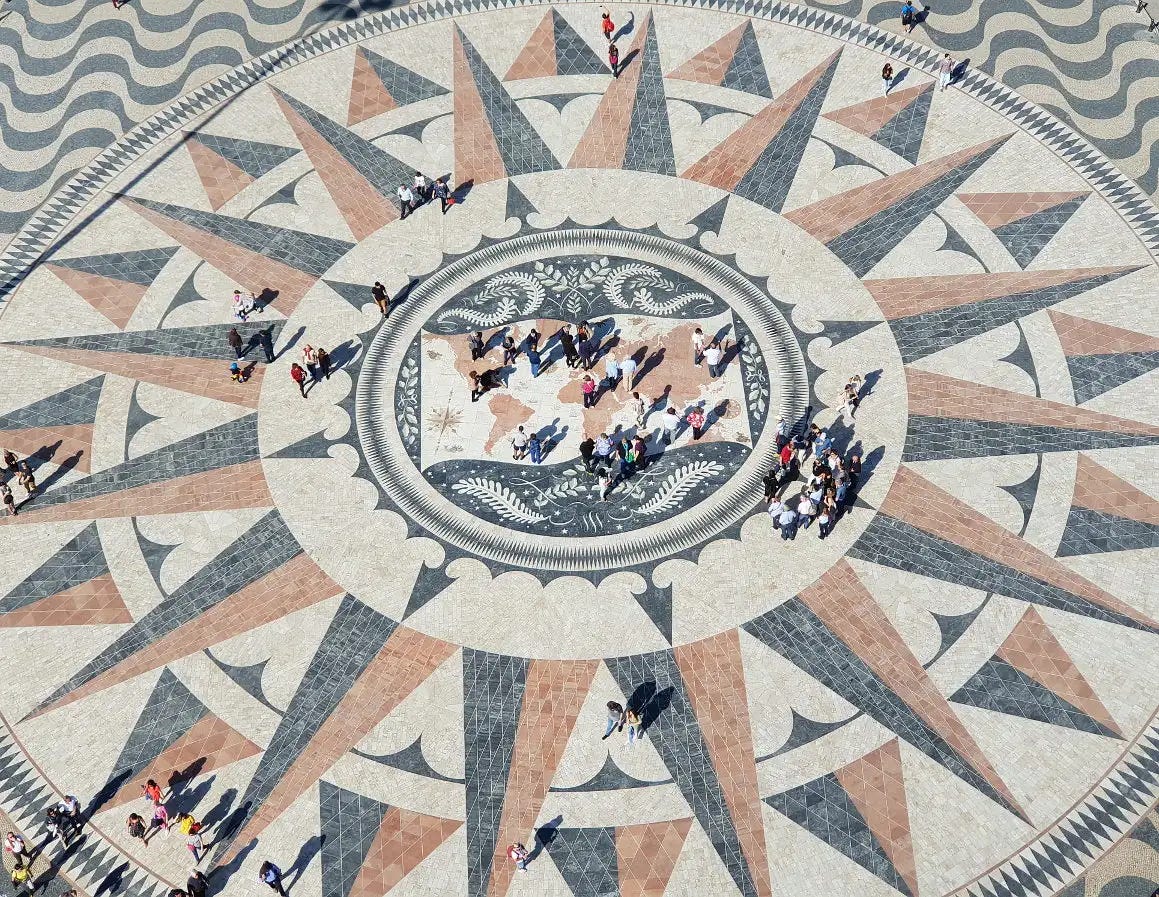
The four cardinal points of the compass point to where you might go, away from here. The promise of the distant unknown seems to demand all our attention. Human beings are, after all, extremely curious about what lies over there, beyond the horizon – to the north, west, east or south. And so it is easy to forget the central ground, which lies between the four main directions. When you’re not going anywhere, you’re still somewhere. Four plus one makes five: five elements, five phases, five movements, 五行. Four directions take you to ‘there’. The fifth ‘direction’ on the compass is ‘here’.
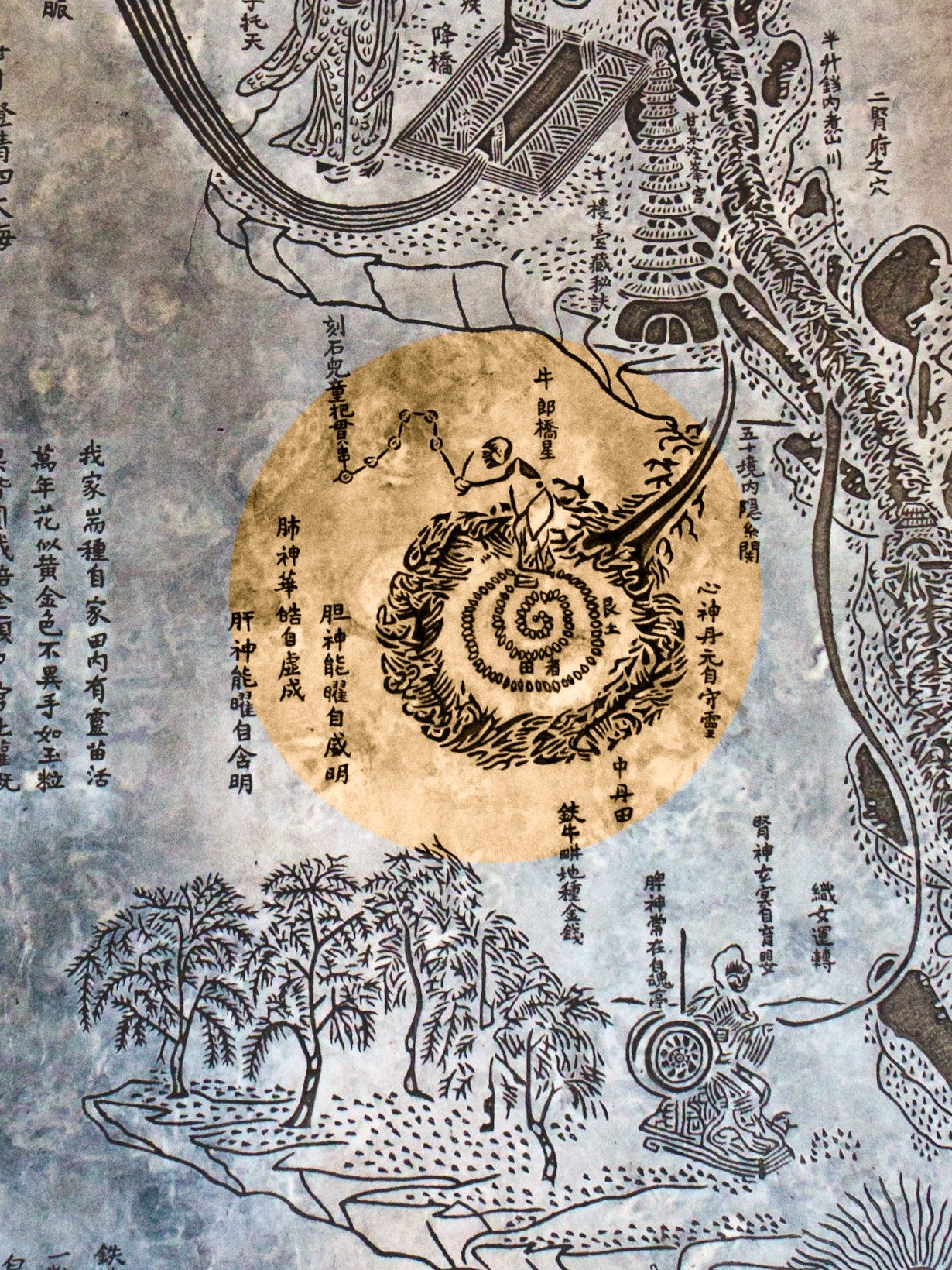
A unique and somewhat unconventional insight into stillness can be found in the Nei Jing Tu, ‘The Map of the Inner Landscape’. Roughly in the center of it, you can see a boy, an ox-herder. In his hand, he holds something unusual: the constellation of the Great Dipper. This is situated directly next to the North Star, which lies in line with the Earth’s axis. Whilst the rotation of the Earth causes all the stars, planets, and the moon to trace circular paths across the firmament, Polaris remains stationary. The boy and the Great Dipper represent the axis around which our lives revolve, the hub of the Great Wheel.
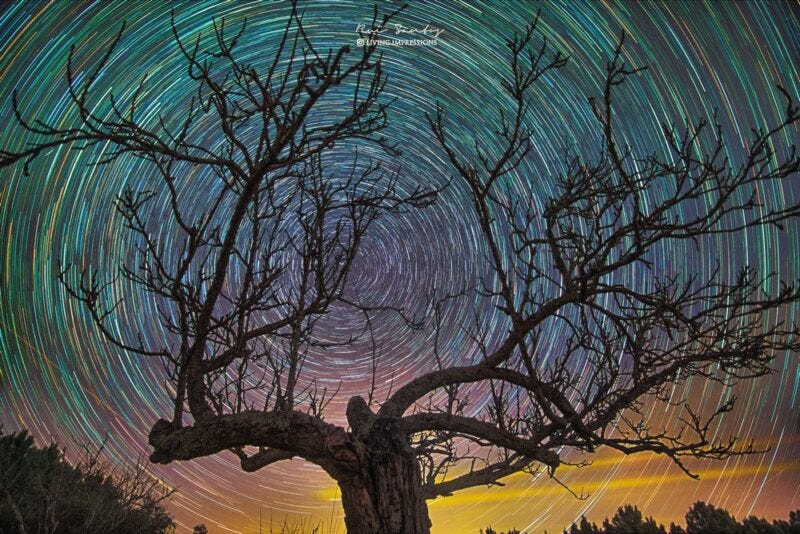
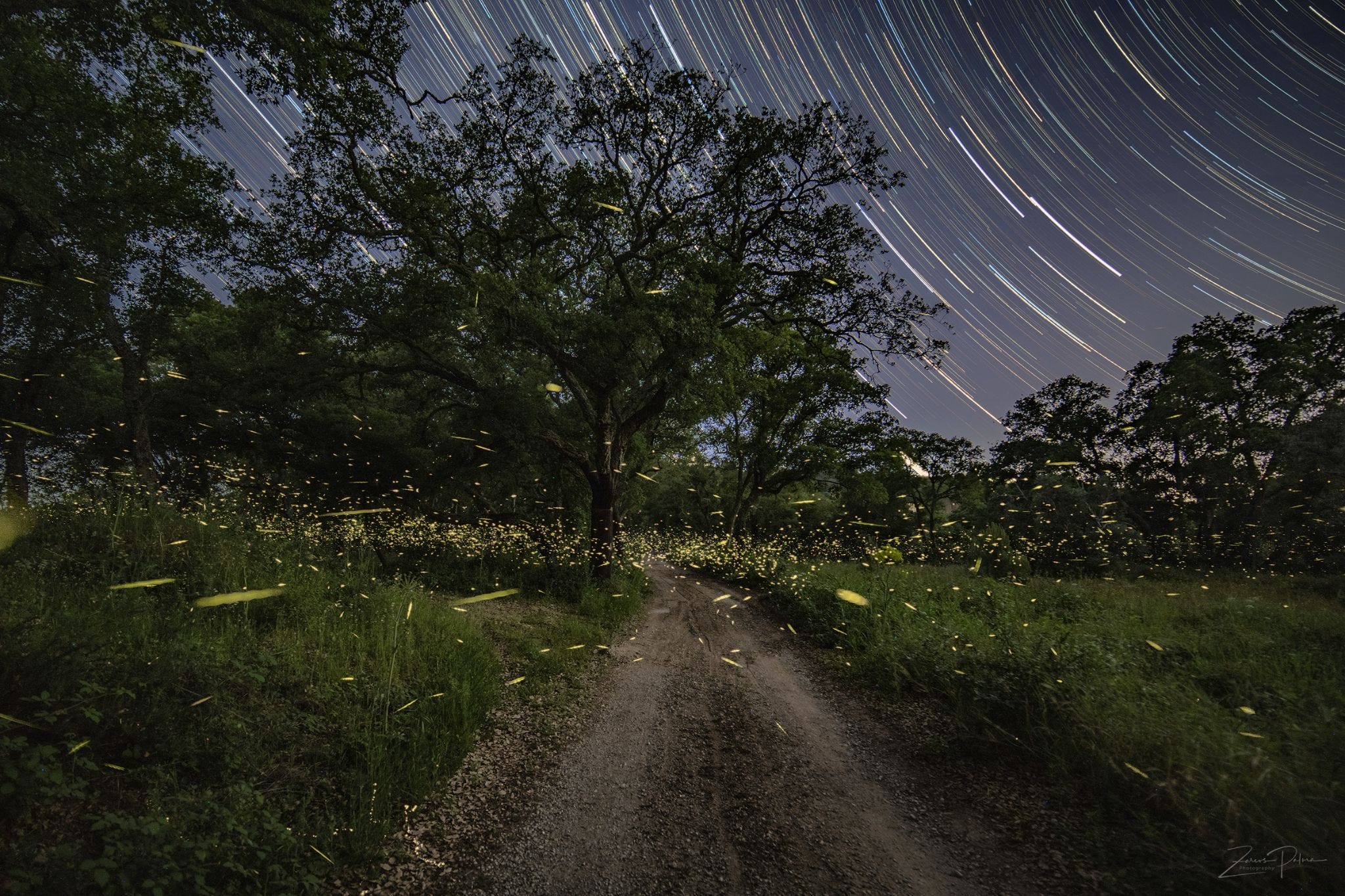
Star trails show the motion of the stars over the sky during a period of minutes or hours. With a steady mount, long exposures and a few other tricks, you can take images of star trails, too. Often, the camera stays pointed at Polaris, the North Pole Star. In the Southern Hemisphere, photographs can point at the south celestial pole (not marked by a single star). Then, with an open shutter, the camera records an image as Earth turns on its axis and the stars move overhead.
earthsky.org
And finally, a truly remarkable illustration of star trails by the Japanese scientist and painter Tsuneo Iwasaki. The trails consist of the text of the Heart Sutra, rendered in delicate brushstrokes. ‘Form is emptiness, emptiness is form.’
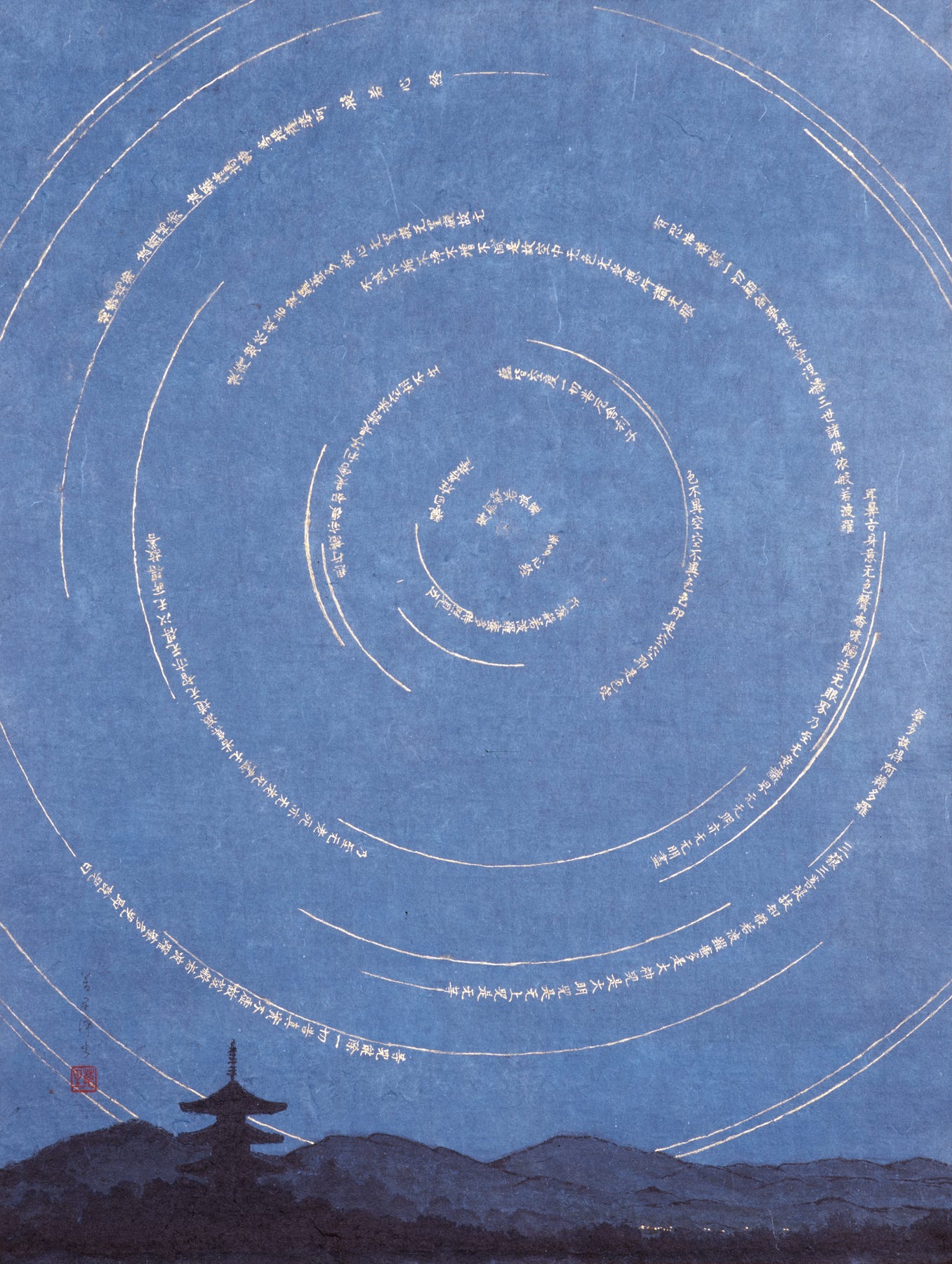
Iwasaki Tsuneo (1917-2002) was a Japanese scientist, teacher, and painter. He developed a practice that embeds calligraphy of the Buddhist Heart Sutra into visual compositions, often drawing on his scientific background.
Artist’s Statement
As I entered the path of faith (shinjin) and copying sutras, I gradually began to wonder if it was possible to make sutras more of a path. Eventually, I started copying sutras in miniature and copying Buddha images, but no matter how well written, if I only copied them in small size, they would be about me, and that would not make others experience the teachings of the sutras in a moving way.
While I was wondering if there was a better way to do this, I came up with the idea of drawing a scene that would fit the teaching and then integrating a copy of the sutra as inconspicuously as possible, so that the calligraphy and painting would become one. I realized that doing so would make the painting come alive and shine.
Anyone at any time can look at paintings in a relaxed manner and be moved by them. When viewed closely, sutras, Buddhas, and teachings will appear in the shadows, offering a fresh perspective. I believe that if I create works like this, people will be able to come into contact with the teachings of the Buddha without any resistance, without knowing it, in an easygoing way, and with peace of mind, so I have worked hard to research and produce tiny-character sutra copying and Buddha image copying.
My purpose for doing tiny character sutra copying paintings is for you to see the teachings of the Buddha, to see the Buddha, and I am deeply grateful to dwell in the heart of the sutra. Also, contemporary people who have lost themselves in busy-ness and whose hearts are dissolute, I pray they feel the same succor and compassion when they look at these paintings.
*
And can we start referring to the ‘Deep North’ and the ‘High South’ from now on?
*
