
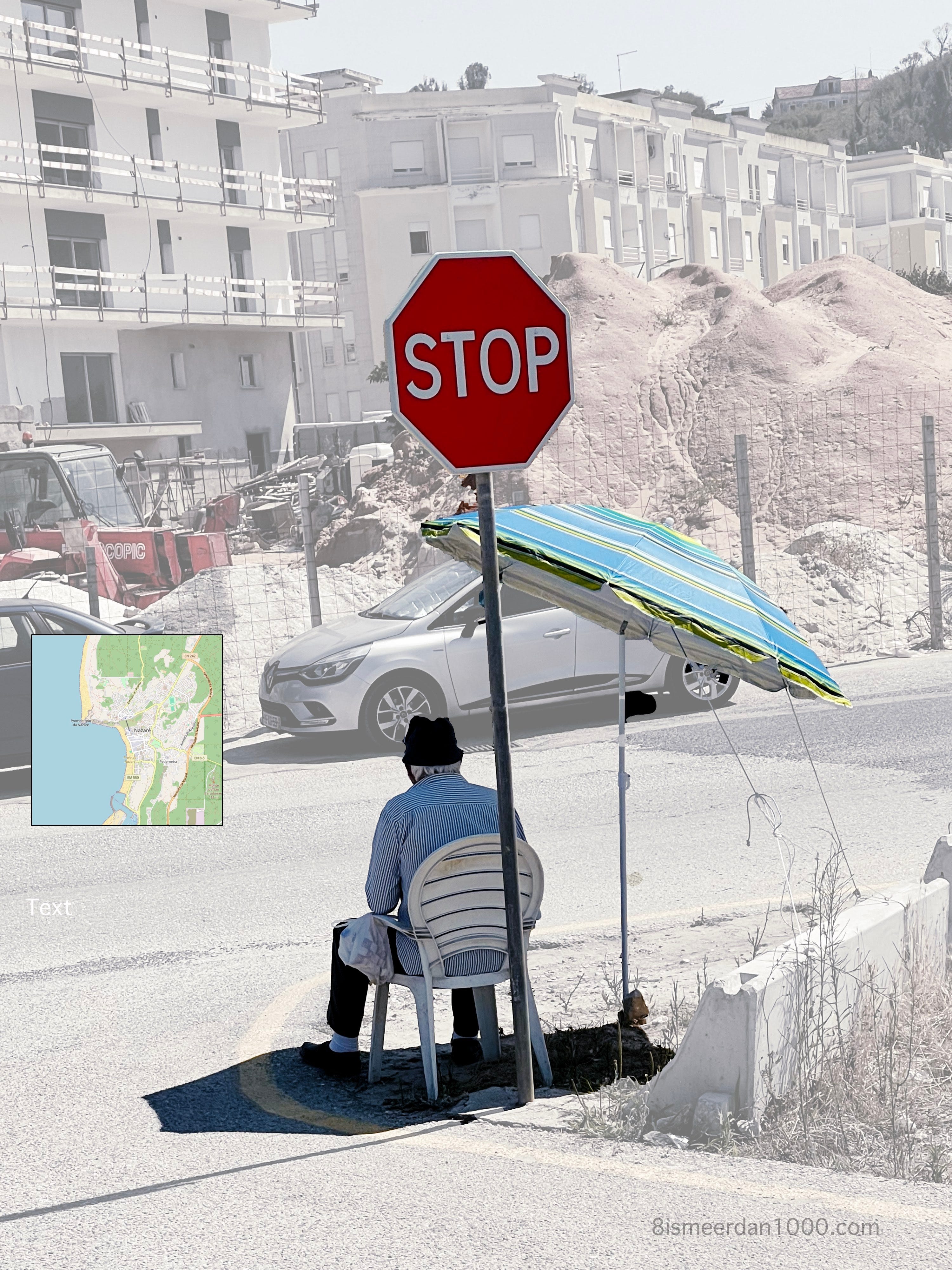
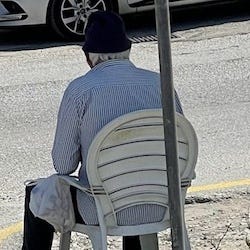
Is he a parking warden? Is he keeping an eye on the building site across the street? Every day when I take the short walk to the square, he’s sitting there. Whatever he’s doing, he’s a master at sitting. That much is clear to me. We didn’t exchange a word at first, but later on these days, the image of him sitting came back in my mind
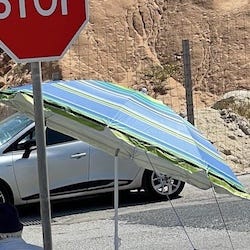
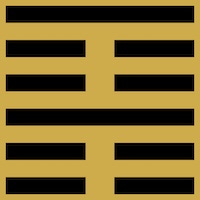
On sunny days – and these are by far the majority – his parasol is open. Tied to the side of his chair is a plastic bag containing, I imagine, some provisions. The stop sign he invariably sits next to underlines his competence. All in association with Mountain, Keeping Still.
This morning I saw him sitting on a white plastic chair. We’ve recently started saying hello to each other. Perhaps he, in turn, wonders what sort of man it is who walks past, most days of the week, slowly and somewhat uncertain. The parasol provided him with some much-needed shade, and the way he was sitting struck me as even more convincing this morning than on previous days.
That unforgettable scene from Akira Kurosawa’s Kagemusha, The Shadow Warrior. An endless, bloody struggle is raging between the various Japanese warlords. One of them has gained the upper hand, and his victory will surely spell the end of the civil war. However, his death – the man is already advanced in years, and an assassination cannot be ruled out – could still throw a spanner in the works.
A double of the warlord is found in the form of a thief sentenced to death. He bears a striking resemblance but has none of the other man’s noble lineage or martial charisma. Should misfortune strike whilst victory is within reach, he will have to take the other man’s place.
From now on, the man sentenced to death is the ‘shadow warrior’. In the utmost secrecy, he is trained in every respect to be the exact replica of the warlord: in his movements, his speech, the way he gallops on his horse before the assembled troops to inspire them with great enthusiasm, and the way he treats the warlord’s wives. Not even they must notice the difference.
The most impossible task, however, is to sit like the old general, to sit like a mountain. Motionless. Unyielding.
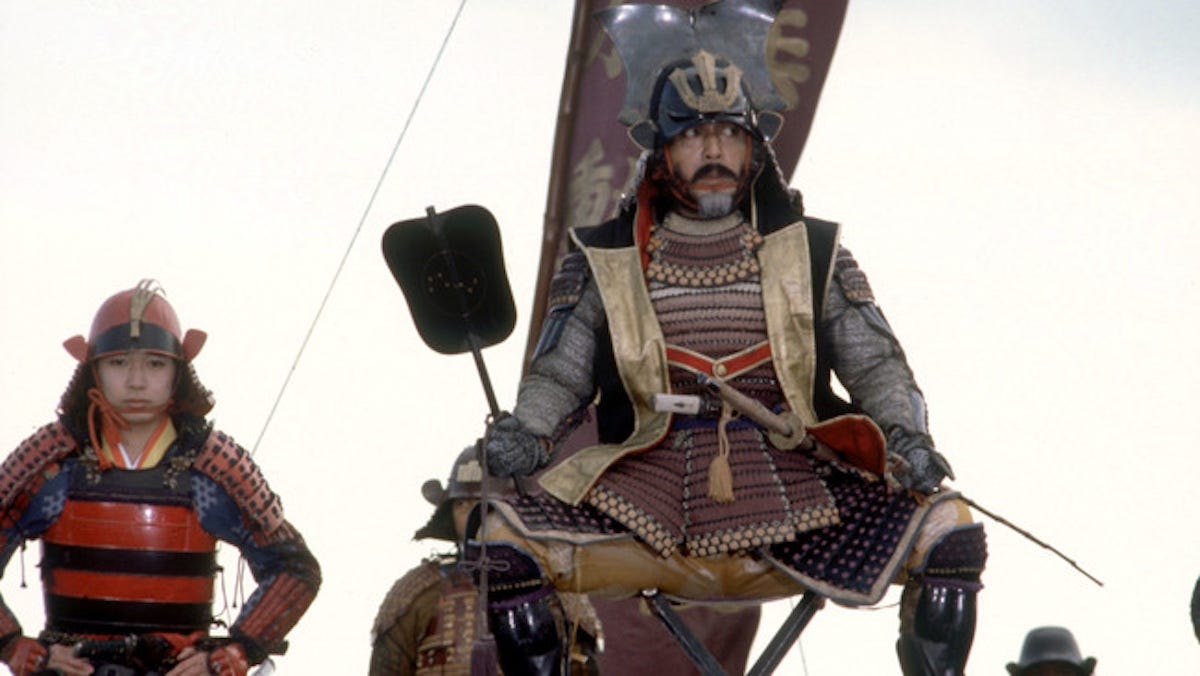
And there he is, at last. The general is dead, and he has taken his place. The final battle has erupted in all its ferocity, and things seem to be going the wrong way. Surrounded by his officers, cut off from their army, the shadow warrior sits on a hilltop. The enemy is approaching, and, as the mist lifts slightly, they find themselves face-to-face. Can the shadow warrior fulfill the ultimate task of sitting firm as a mountain?
The focal character in the midst of all this pageantry is one who doesn’t belong there at all: a common thief, who has been rescued from crucifixion because of his uncanny resemblance to Lord Shingen. He is trained to act as the lord’s double, or kagemusha, a common practice in those days that could be put to many tactical uses. He learns how to walk, talk, and contemplatively stroke his mustache well enough to make cameo appearances, but when Lord Shingen is felled by a sniper, the thief must take over his role completely. Now the destiny of the clan depends on his not only rallying the lord’s troops but deceiving his grandson, his concubines, and—hardest of all—his horse.
And this is where we, who will probably never vie to plant our flags in Kyoto, connect with the film. As in the story of the two thieves crucified alongside Jesus, it gives us someone we can identify with. For we’re all imperfect, we’ve all done wrong, and, it can even be said, this side of enlightenment we’re all thieves, compulsively snatching what gratification we can from our surroundings, our books and movies, our families and lovers—from anywhere but within ourselves. The thief’s opportunity to ascend to the dignity and power of the lord suggests our own aspiration to rise to something higher. Like him, we usually need some kind of model, whether it’s our teacher or the Buddha or some world-improving secular bodhisattva, be it Einstein, Coltrane, or our nurturing grandma. And, like the thief, we may at first have to emulate some of our role models’ more outward virtues till we can feel our way inward to the essence of what makes them what they are. We fake it till we make it.
The kagemusha’s ultimate test, where he makes it on the inmost level, comes in a frightening night-battle scene, where he must sit—just sit—behind his troops. Lord Shingen, who was nicknamed ‘Mountain,’ was famed for the power of his resolute immovability, and now, with bullets flying all around him, the thief is instructed, ‘No matter what happens, remain calm and don’t move.’ It’s essentially the same test taken (and aced) by Shakyamuni, assailed by the troops of Lord Mara under the Bodhi tree, and it’s the same test that we take every time we sit.
The Shadow Knows - Dean Sluyter (Tricycle voorjaar 2007)
The Ten Wings is the famous commentary on the I Ching. Or rather, it is the text that transformed the Zhou Yi, an oracle book from the Bronze Age, into a seminal philosophical work, essential to Chinese culture. The Eighth Wing, the Shougua, deals with the eight trigrams and their respective associations. A mountain is certainly not just a mountain. According to the Shougua, the essential quality of The Mountain can also be found in a dog, a gatekeeper, a city wall, a clap of thunder, the making of clothing, a tail, a nose, the upper arm, discretion – the list is long. Some associations are obvious; others require explanation or reflection.
In the photograph, The Mountain and Keeping Stil – alongside the man’s steady sitting posture – are represented by:
#1 a chair …
#2 a pile of sand …
#3 a concrete barrier …
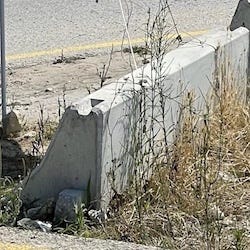
3# the cliff around the lower part of Nazaré (you can just about make out a small section of it in the top right-hand corner) …
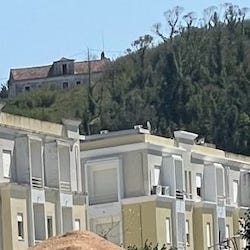
#4 the houses on the other side of the street …

#5 the urgent advice to stop …
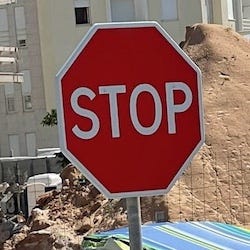
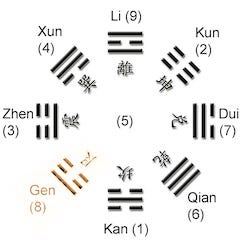
#6 the octagonal shape of the stop sign, similar of that of the ba gua …
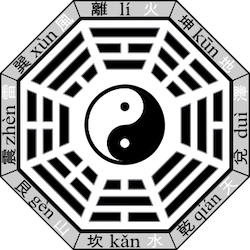
… and in the ba gua, the number 8 is assigned to The Mountain (Gen, in the north-east, bottom left) …
#7 the man’s back and the back of the chair (see also ‘North’ in this context) …
#8 the parasol shaped like an upturned bowl, just like the Berg trigram …
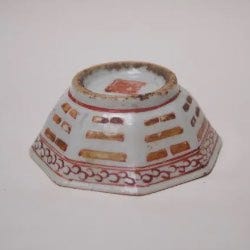
All of that alongside the main subject of the photograph: a seated person, as still as a mountain.
*
