
EIGHT>1000 Post
Sunday 26 July 2026
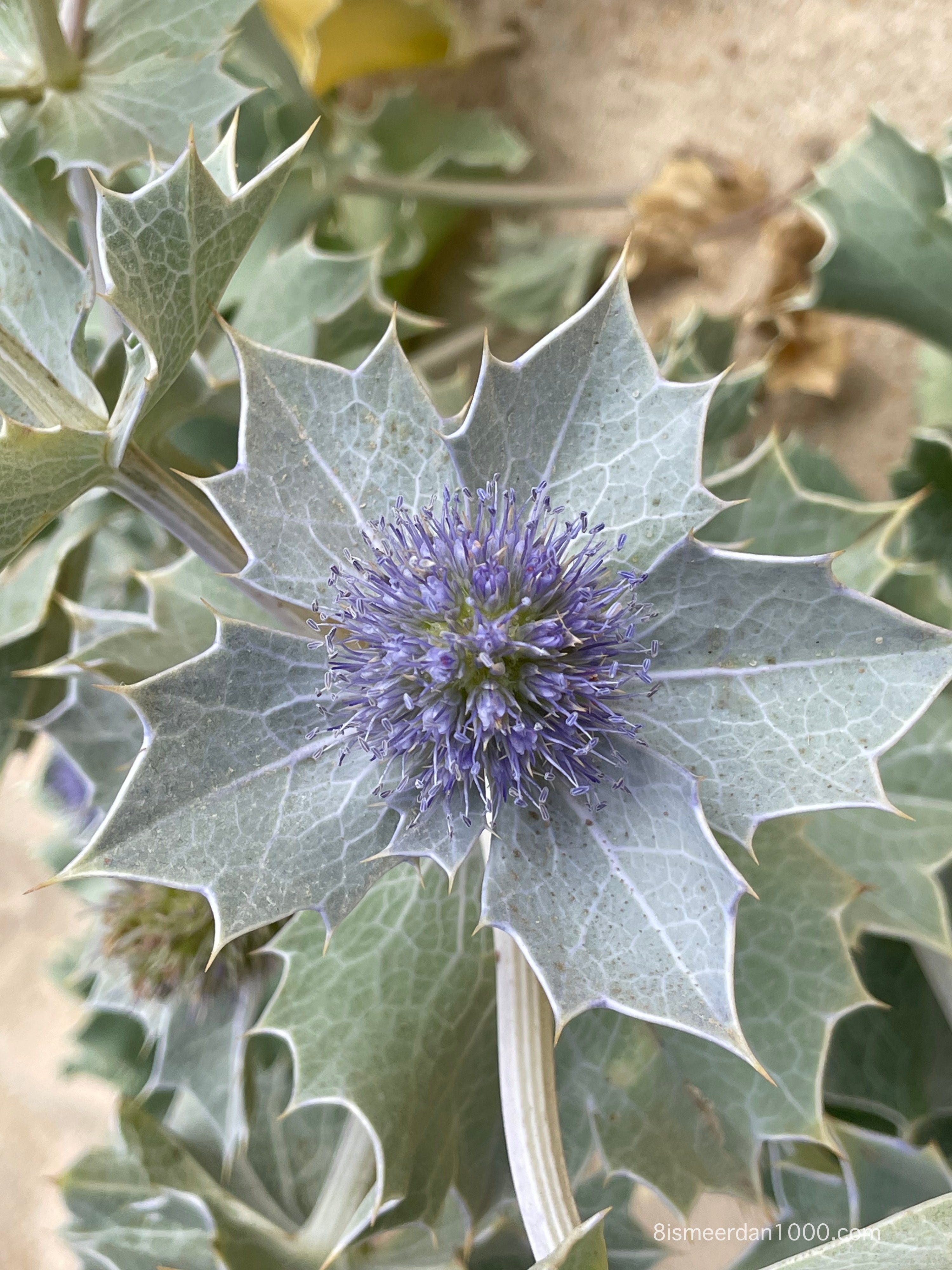
Blue sea holly on Nazaré beach. It takes some nerve. Settling down as a pioneer on loose sand. The sea, the wind, people’s shoes – everything has free rein. You just have to fend for yourself on the open beach. Fortunately, an observant soul has put up a sign: ‘Young dunes, still forming – watch your step!’ The sea and the wind may not pay any heed to signs, but it’s a start, at least. Save the world – start with the blue sea holly.
A blue sea of thistles
There are more blue sea thistles on Schiermonnikoog than ever before. The plant used to be a rarity. For the past ten years or so, I’ve been finding them every year, even when I’m not really looking for them. But this year I’ve come across a blue sea of thistles: absolutely stunning!
‘Thistle’ is a misleading name. Although the plant looks like a thistle and is prickly, it is not a thistle. In fact, it is not even a composite, the large family of flowers to which thistles and dandelions belong. Blue sea thistles are related to cow parsley, hogweed and ground elder – they belong to the umbellifer family.
At marker 10, I find some large specimens in full bloom. A good five kilometers further east, the higher part of the beach, with its young dunes, is a sea of blue.
I sometimes give talks on Schiermonnikoog, using nature photographs of the island. Thirty years ago, Henk Koning, the island’s schoolteacher, used to do the same. I used to go to those talks as a child. I remember two particular slides: one winter scene of wild swans flying past the Oude Steiger in the ochre-yellow winter sun, which I remember because I thought it was such a beautiful image. Koning thought so too; he called it a treat, as wild swans were certainly not a common sight on Schier. The other slide showed a blue sea thistle, about which the nature expert explained that there was only one of them on Schier.
Koning had no idea that a beach marker was faintly visible in the photograph, which could apparently be identified as marker 15. In any case, that single sea thistle had been pulled up a few days later. Blue sea thistles were popular as dried flowers, even though their blue colour turned brown as they dried. The plants were even in danger of disappearing from the Dutch dunes because people were taking them away.
But it’s no coincidence that the blue sea thistle is related to cow parsley, hogweed and ground elder; it spreads rapidly thanks to its abundant seeds. Thanks to the wind, seawater and rabbits’ fur, the species has made a comeback. And now there are so many of them!
Koos Dijksterhuis - Natuurdagboek Trouw maandag 16 september 2019
*
SITTING

Is he a parking warden? Is he keeping an eye on the building site across the street? Every day when I take the short walk to the square, he’s sitting there. Whatever he’s doing, he’s a master at sitting. That much is clear to me. We didn’t exchange a word at first, but later on these days, the image of him sitting came back in my mind
*
And tomorrow morning, of course: the week kicks off with music. Have a lovely Sunday!
*
